
Commercial Real Estate Capital Markets Enter a Transitional Phase
Max Shpilband for Market Share Blog | May 5, 2026
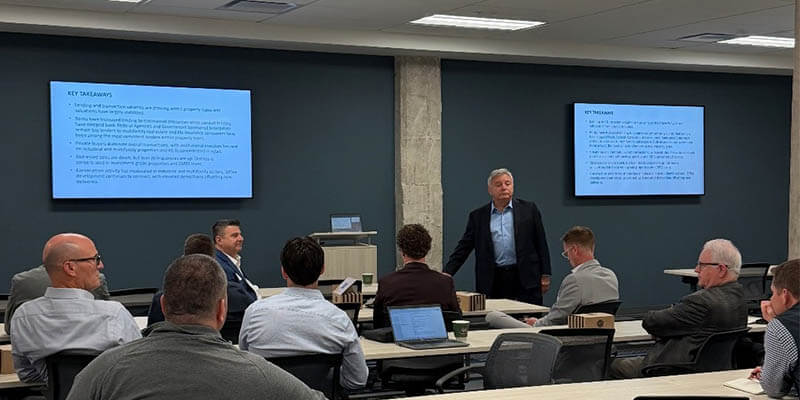
Commercial real estate professionals gathered for a capital markets briefing hosted by NAIOP Utah during NAIOP’s National Forums Symposium in Salt Lake City last week. Will McIntosh, Ph.D., senior visiting Fellow of the NAIOP Research Foundation and CEO of ArcBridge Research Group, LLC, shared his assessment of where the market stands and what risks remain.
McIntosh focused on how the CRE market is adjusting after a sharp repricing cycle. “The commercial real estate market is going through a real interesting transition period,” he said. Liquidity is beginning to return as banks slowly re-enter the lending market, transaction activity is picking up from recent lows, and valuations appear closer to stabilizing after several difficult years. At the same time, he emphasized that the market remains highly sensitive to interest rates and capital market volatility, which continue to shape pricing and investor behavior across asset classes.
The economic picture: slow growth, real constraints
The U.S. economy continues to grow, though at a slower pace. GDP growth is expected to be around 2.2% in 2026. McIntosh described that as modest but still constructive. Consumer spending has softened as households remain cautious about prices and employment. Job growth has slowed, though unemployment remains relatively low by historical standards.
Business investment is helping offset weaker consumer demand, particularly spending tied to technology and artificial intelligence. That investment has provided meaningful support for economic activity during a period of uncertainty.
Inflation has eased from recent highs but remains above the Federal Reserve’s (Fed) 2% target, keeping pressure on interest rates and capital markets. Elevated energy prices and geopolitical tensions continue to complicate the outlook.
Why interest rates and the 10-year Treasury matter so much
Much of the risk in today’s real estate market comes back to interest rates. While the Fed controls short-term rates, McIntosh emphasized that long-term rates are what matter most for commercial real estate. “The one I worry the most about is not the federal funds rate. It is the 10-year Treasury,” he said. The 10-year Treasury drives mortgage pricing, cap rates and investor returns. Recently, it has remained in the 4% to 4.5% range, helping bring some stability to values. However, large federal borrowing needs mean significant bond issuance ahead. If investors demand higher yields to absorb that supply, long-term rates could rise again, putting renewed pressure on cap rates and valuations.
McIntosh cautioned that if inflation reaccelerates, whether due to energy prices or prolonged global conflict, interest rates could rise further and extend market volatility.
Lending conditions and transactions begin to normalize
One encouraging trend is the gradual return of liquidity. Banks are stepping back into the market after pulling back sharply in recent years, helping support refinancing activity and transaction volume. This shift away from heavy reliance on private debt has been important for market stability.
Lenders remain conservative. Loan-to-value ratios are lower, underwriting standards are tighter, and refinancing is still difficult for some borrowers. In multifamily, government-sponsored enterprises continue to provide most of the capital, while banks and insurance companies are lending selectively on high-quality assets.
View archived blog posts at: http://naiopcharlotte.wordpress.com