
Office-to-Apartment Conversions Accelerate as Adaptive Reuse Reshapes the Rental Pipeline
Florin Petrut for Market Share Blog | April 14, 2026
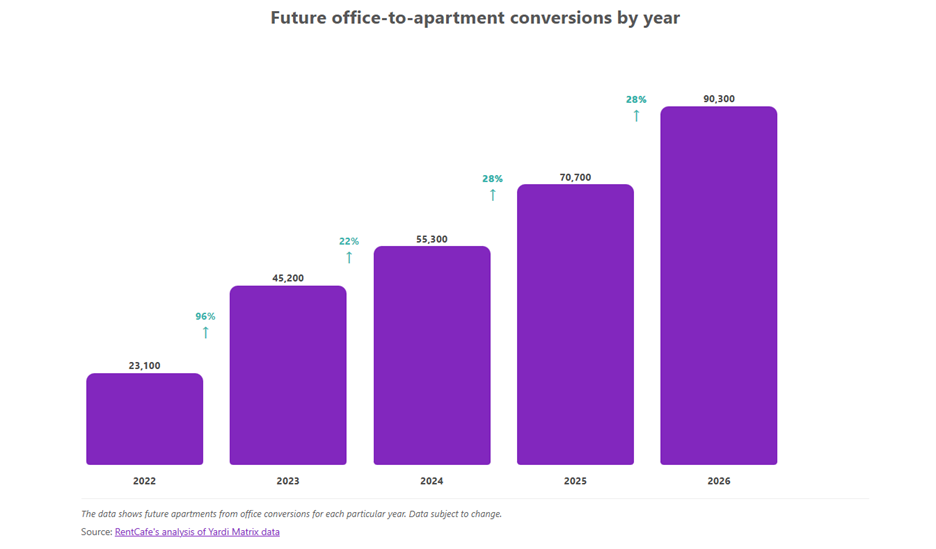
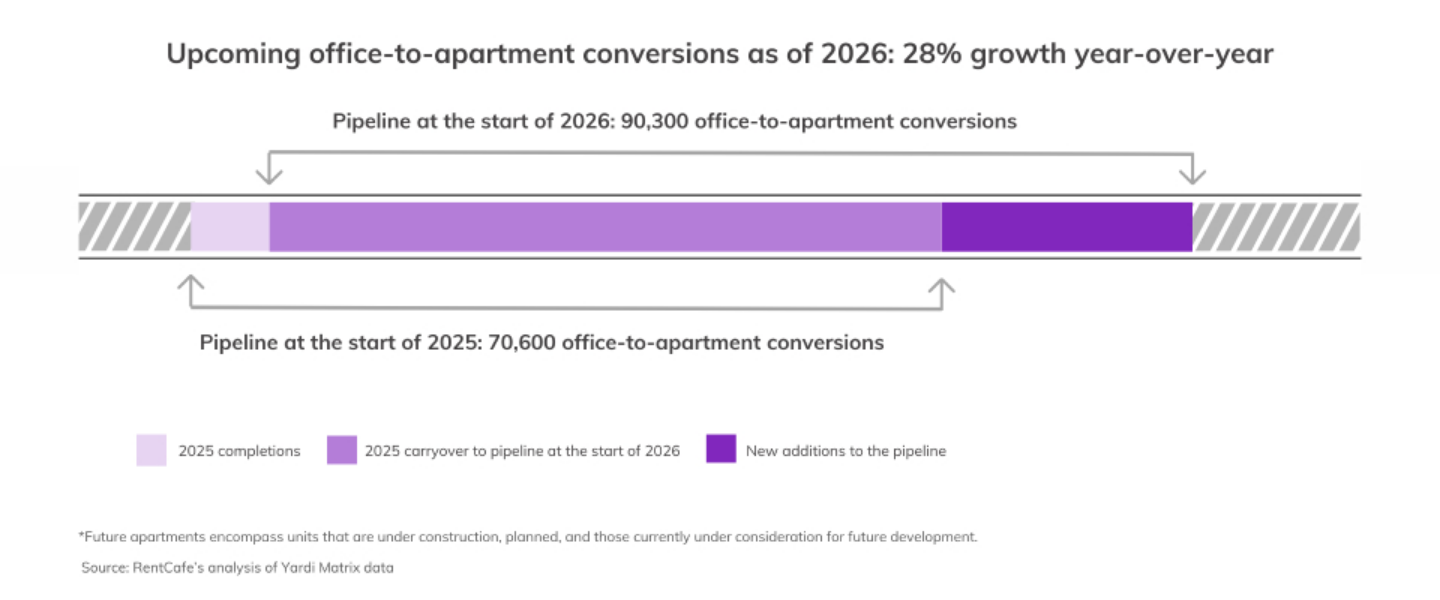
A record 90,000 apartments are now in the U.S. pipeline of office-to-apartment conversions, according to RentCafe’s latest analysis of Yardi data – a sign that each year shifts adaptive reuse even more from niche strategy to mainstream development tool. The surge comes as office vacancy persists under hybrid work and housing demand remains strong in supply-constrained cities.
“Office-to-residential conversions are no longer just a workaround for distressed buildings – they’re becoming a strategic tool for adding housing in supply-constrained markets,” said Doug Ressler, senior analyst and manager of business intelligence at Yardi Matrix.
A FAST-GROWING PIPELINE FUELED BY MARKET SHIFTS
The rise in conversions reflects two key trends coming together: higher office vacancy rates and an ongoing need for more housing. As companies reassess how much space they need, some office buildings – particularly older ones – are seeing lower demand. At the same time, renters continue to face limited housing options in many desirable urban locations.
This imbalance is creating opportunities for developers to reposition office assets into residential units. Compared to ground-up construction, conversions can offer a faster path to delivery in well-located areas where zoning and land availability might otherwise slow new development.
Still, not every building is a good candidate. “The feasibility of office conversions depends heavily on building design – factors like floor depth, window access and structural layout can make or break a project,” explained Peter Kolaczynski, director of data and research at Yardi.
Most conversion activity is concentrated in properties built between the 1960s and 1990s, which tend to have layouts better suited for residential use.
View archived blog posts at: http://naiopcharlotte.wordpress.com